

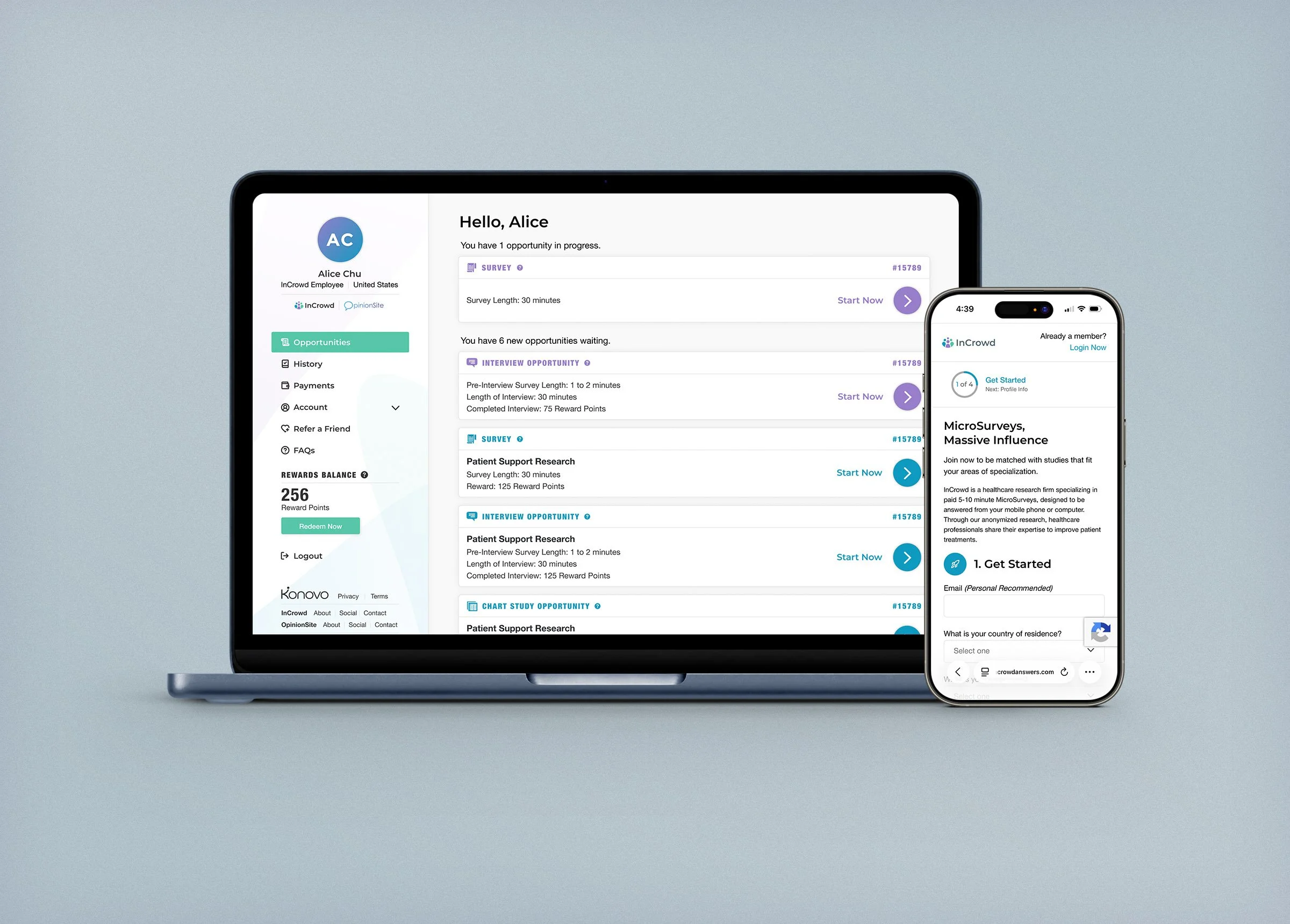
InCrowd: Respondent Portal & Registration
Creating a Revitalized Market ReseArch Respondent Experience
Role: Lead Product Designer
Timeline: April 2025 – August 2025
Teams: Product, Engineering, Panel Operations, Customer Support, Marketing
Responsibilities: Product Strategy, User Research, Session Recording Analysis, User Flows, Prototyping, Stakeholder Alignment, Design System Development
Impact: Led the modernization of a multi-brand respondent ecosystem, unifying InCrowd and OpinionSite experiences into a single platform while improving registration, survey participation, profile management, rewards redemption, and account management workflows. Enhanced the experience for thousands of healthcare research participants.
Overview
The Respondent Portal and Registration experience served as the primary touchpoint for thousands of healthcare professionals participating in market research studies across two distinct panel brands: InCrowd and OpinionSite. Over time, the experience had evolved into a collection of disconnected workflows, inconsistent interfaces, and aging design patterns that created friction for users and increased complexity for product and engineering teams.
As lead designer, I led the end-to-end redesign and modernization of both the Registration and Respondent Portal experiences. The initiative unified two previously separate brands into a single cohesive ecosystem while preserving the unique requirements of each audience. The goal was to create a cleaner, more professional experience that improved usability, increased trust, reduced support burden, and established a foundation for future product growth.
The Problem
The project involved far more than updating the visual design. Registration alone required navigating a highly complex onboarding journey that included profile creation, credential verification, third-party vendor checks, consent requirements, password management, and compliance-related workflows.
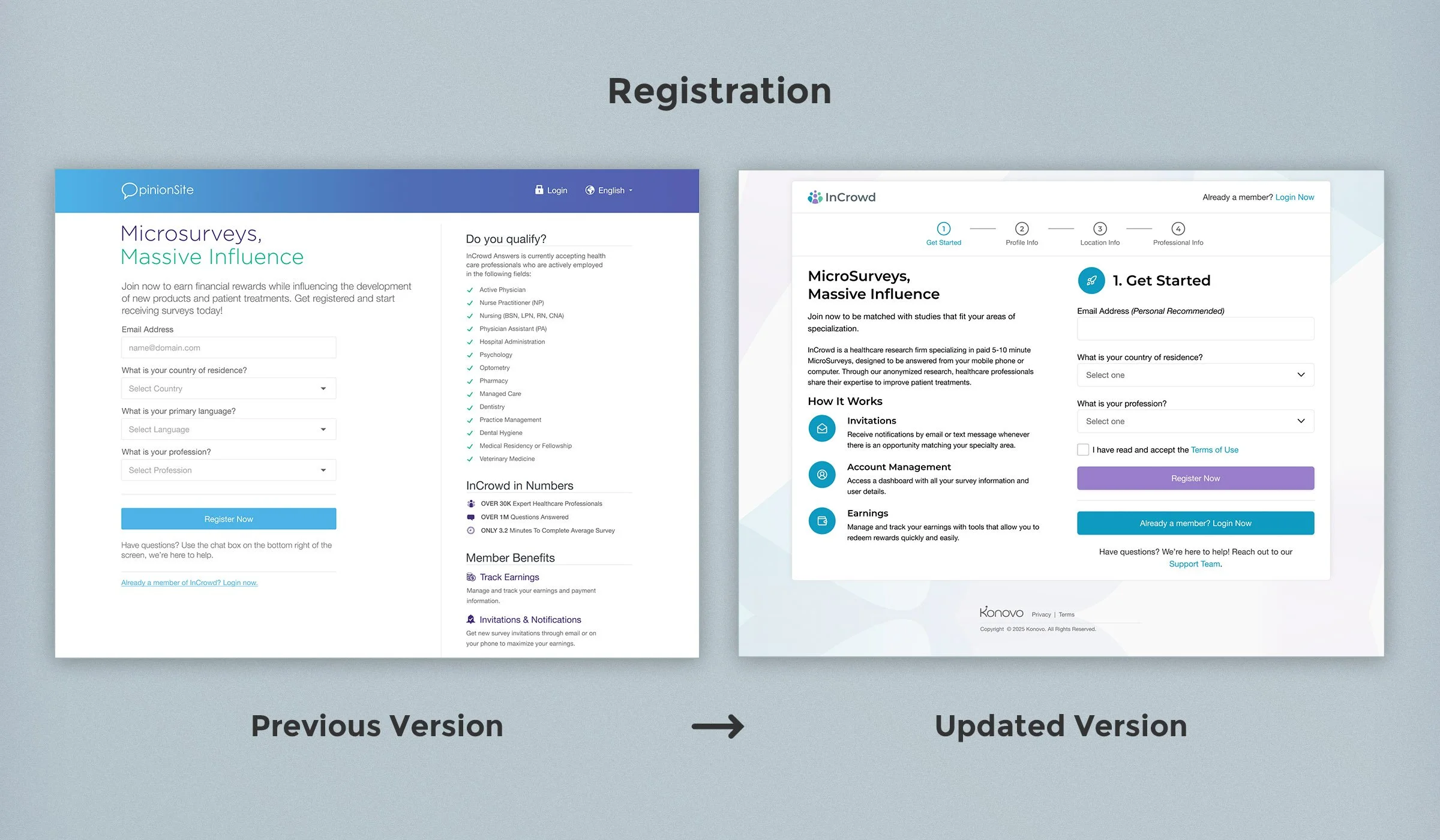
Feedback was that the length of the registration and steps along the process were not clear, leading to a frustrating experience.
At the same time, the Respondent Portal needed to support a wide variety of use cases, including survey discovery, participation tracking, rewards redemption, payment management, profile maintenance, communications preferences, referral programs, account status management, and historical activity tracking.
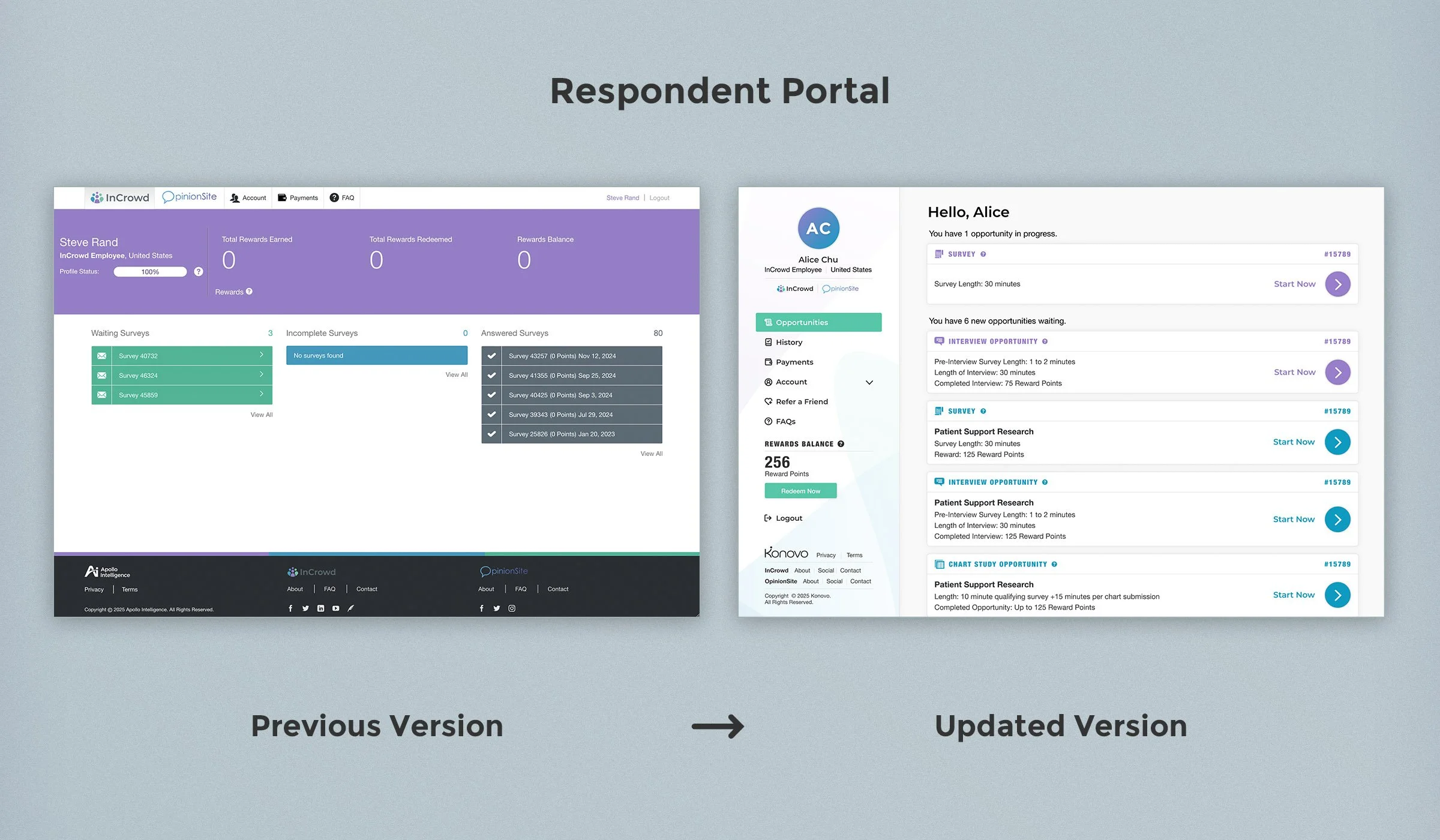
Feedback was that brand segmentation was confusing and hid opportunities from respondent users.
Complicating matters further, the platform supported multiple user types (including single-brand and dual-brand panelists) with different business rules, reward structures, and communication preferences. The experience needed to feel unified while adapting to each user's specific needs.
“The platform needed to support multiple user types with different business rules, reward structures, and communication preferences.”
Research & Design Process
Working closely with product managers, engineers, researchers, and business stakeholders, I created a comprehensive design system and a complete set of responsive workflows covering desktop and mobile experiences. This included combining the visual design needs of both the InCrowd and OpinionSite brands.
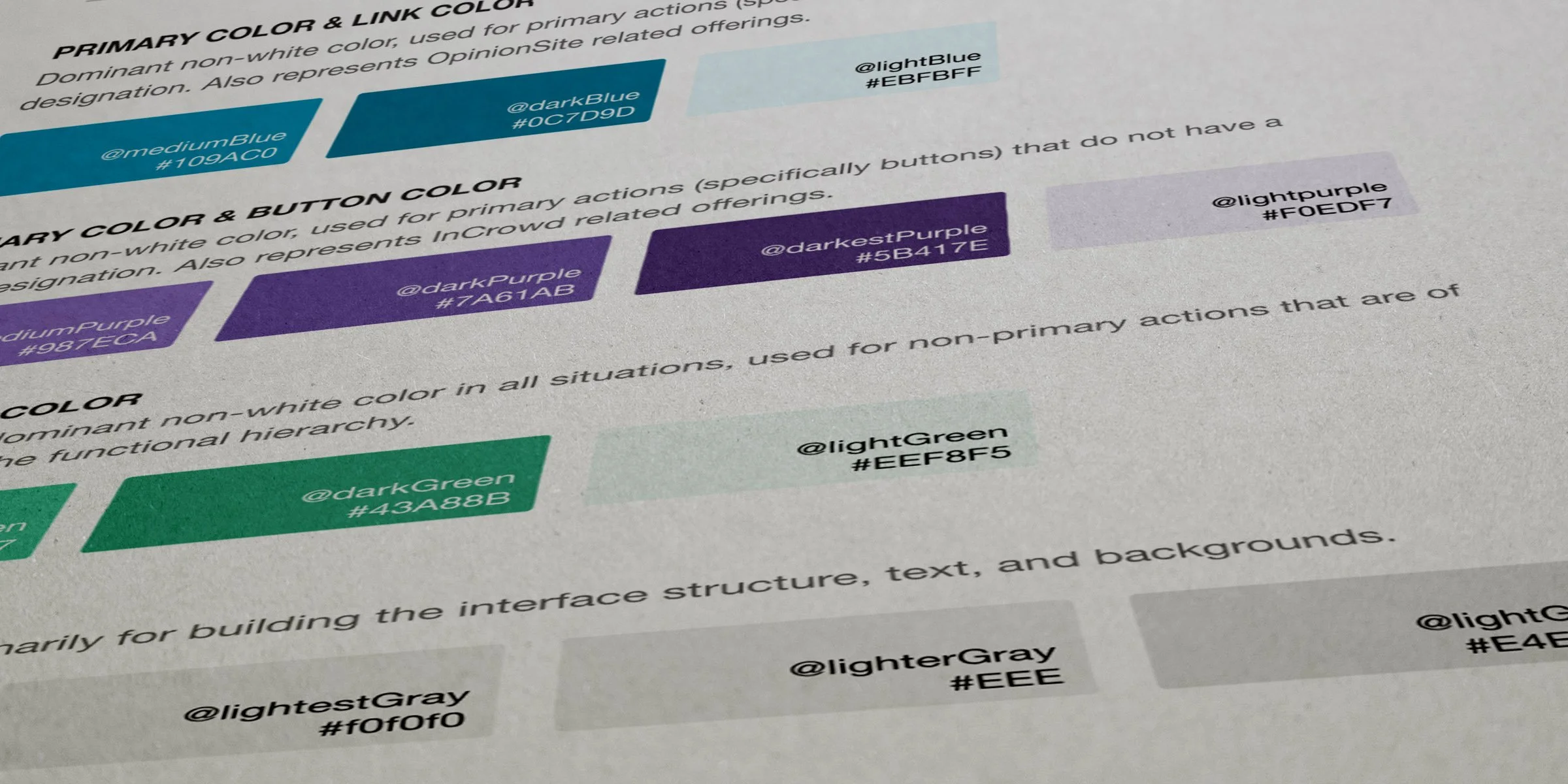
Close up detail of the colors for the design system combining InCrowd and OpinionSite brands.
To validate design decisions, I introduced session-recording analysis into the process, leveraging behavioral data to identify friction points throughout registration and portal workflows. This included analyzing real user interactions around complex inputs and profile completion behaviors, helping the team prioritize improvements based on observed user behavior rather than assumptions alone.
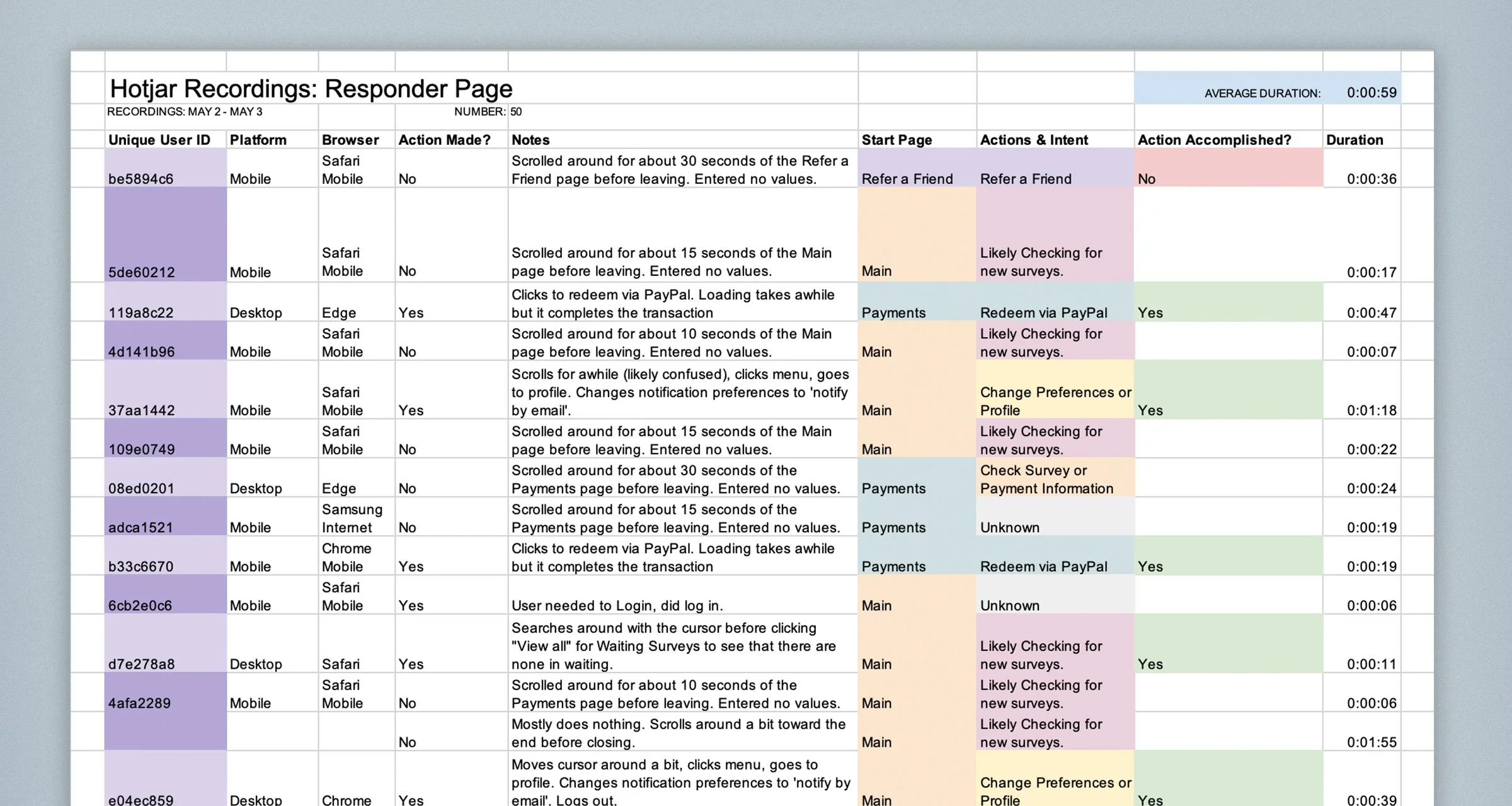
Hotjar session recordings were analyzed and documented for both the Respondent Portal (Above) and the Registration Experience to gather actionable insights.
I conducted behavioral analysis using Hotjar session recordings across both the Registration and Respondent Portal experiences. I observed how real participants navigated the product, revealing consistent patterns around rewards redemption, survey discovery, and profile completion.
The recordings exposed several usability issues, including confusion around incomplete profile requirements, misleading interaction patterns, unnecessary steps in the rewards redemption flow, and interface elements that users repeatedly expected to be clickable. These insights directly informed design decisions throughout the modernization effort, resulting in more intuitive navigation, streamlined redemption workflows, clearer profile completion guidance, improved feedback states, and all reducing user friction across the platform.
Impact
The modernization transformed an aging collection of experiences into a polished, scalable platform that better reflected the professionalism of the Konovo brand. The redesign introduced a significantly cleaner and more intuitive interface while reducing complexity for users navigating critical tasks such as registration, profile management, survey participation, rewards redemption, and account maintenance.
By unifying multiple brands, user types, and workflows into a cohesive experience, the project improved consistency while creating a flexible framework capable of supporting future enhancements. The work also established stronger UX practices within the organization through increased use of behavioral data, session-recording insights, reusable UX patterns, and scalable design system components.
“The Respondent Portal & Registration work established stronger UX practices within the organization through increased use of behavioral data, session-recording insights, reusable UX patterns, and scalable design system components.”
The result was a modern platform that balanced complex business requirements with a user-centered experience, helping participants more easily engage with research opportunities while providing the business with a foundation for continued growth.
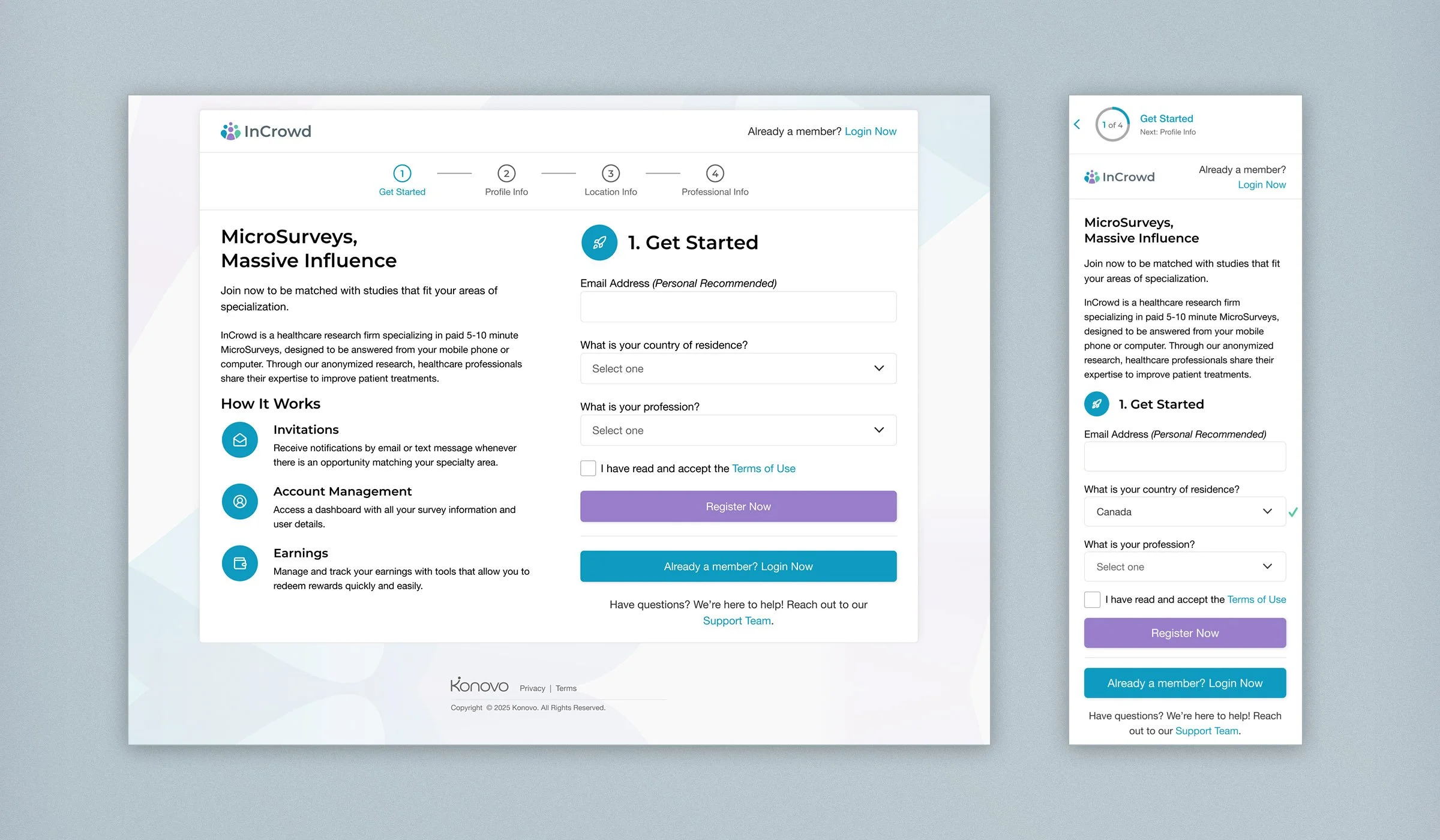
Initial page of the registration process. Sets the registrant’s expectations by clearly labeling that they are on step 1 of 4.
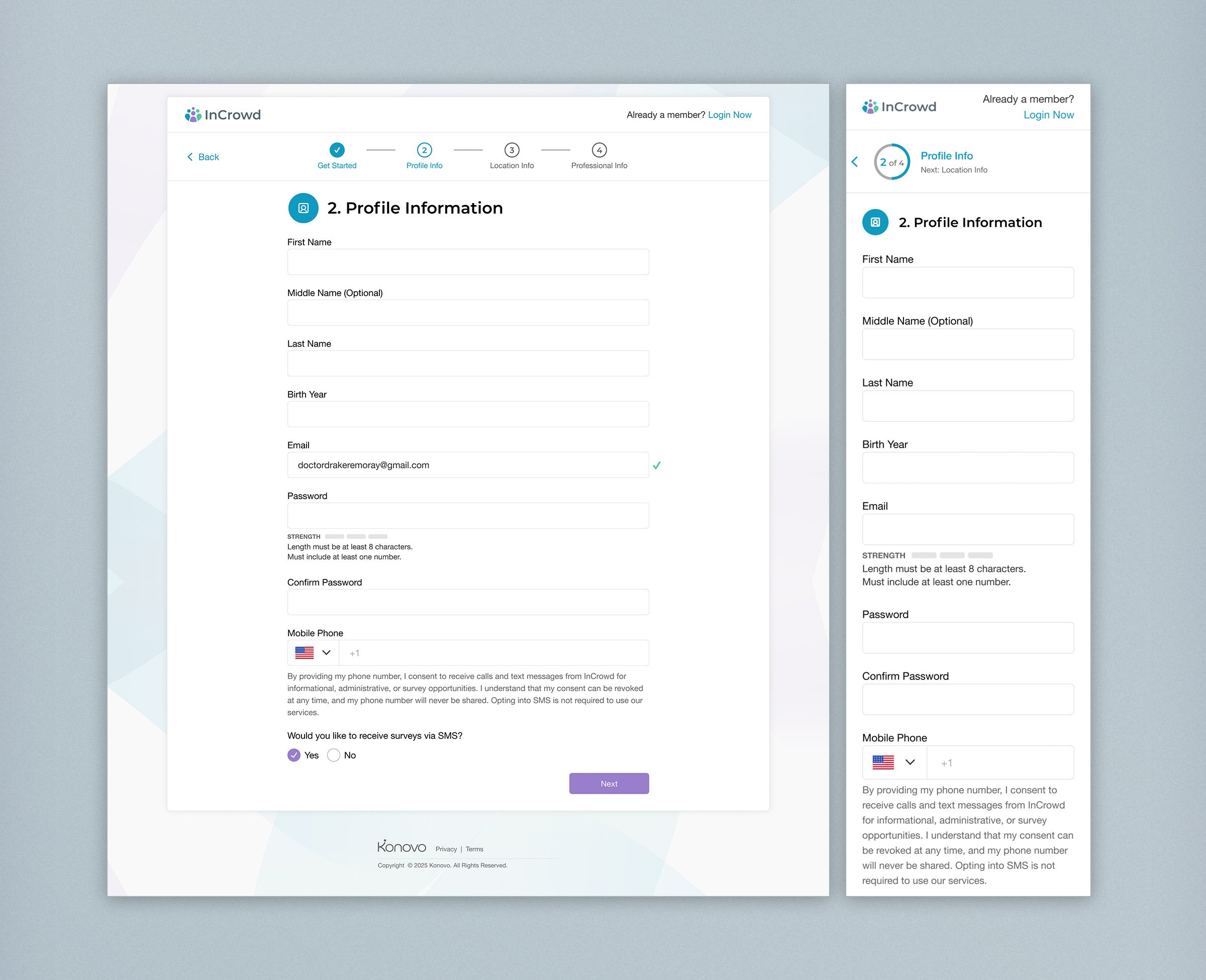
Profile information was separated out from location and professional information, keeping prospective registrant’s focused.
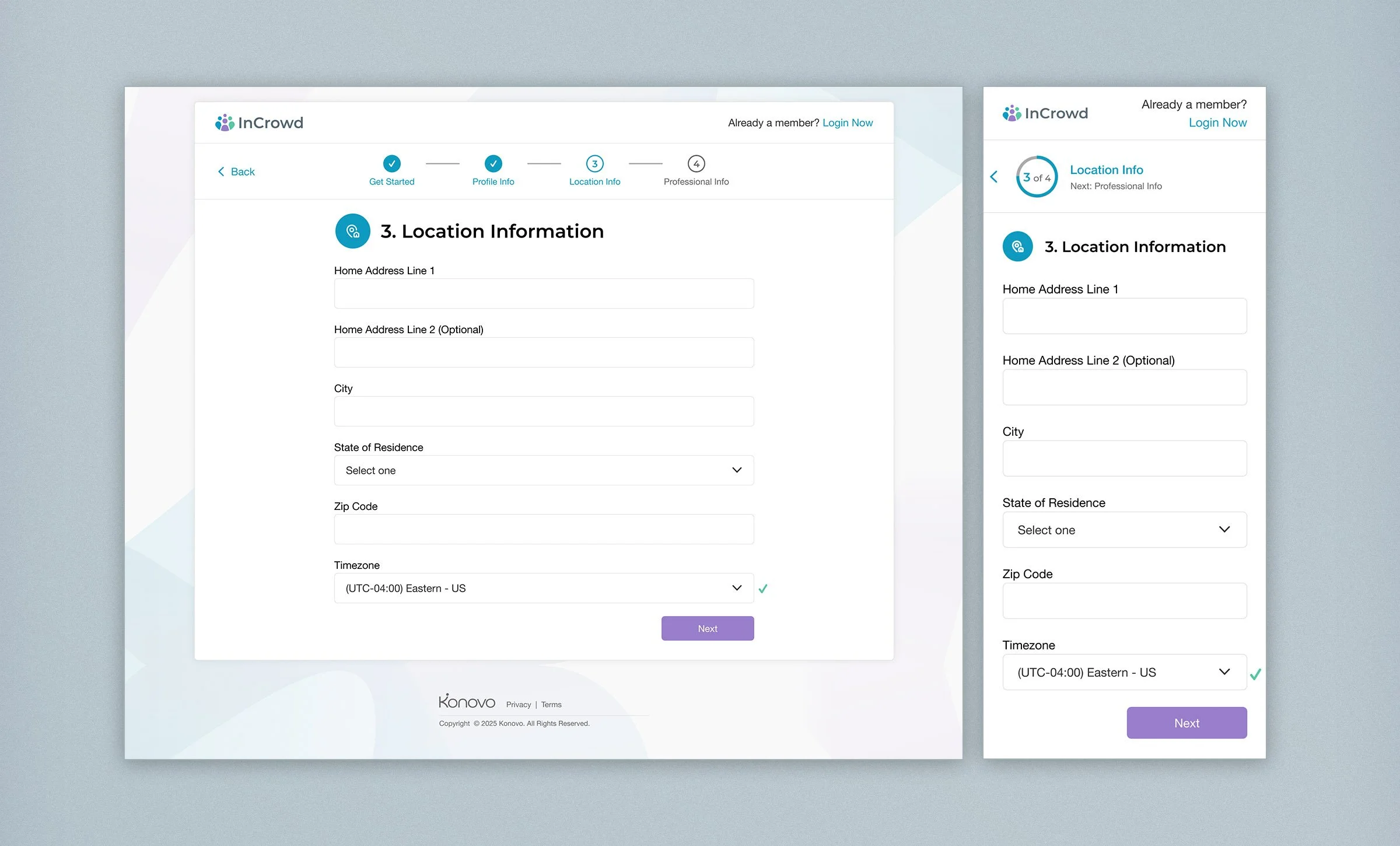
Step 3 focuses on simple location information.
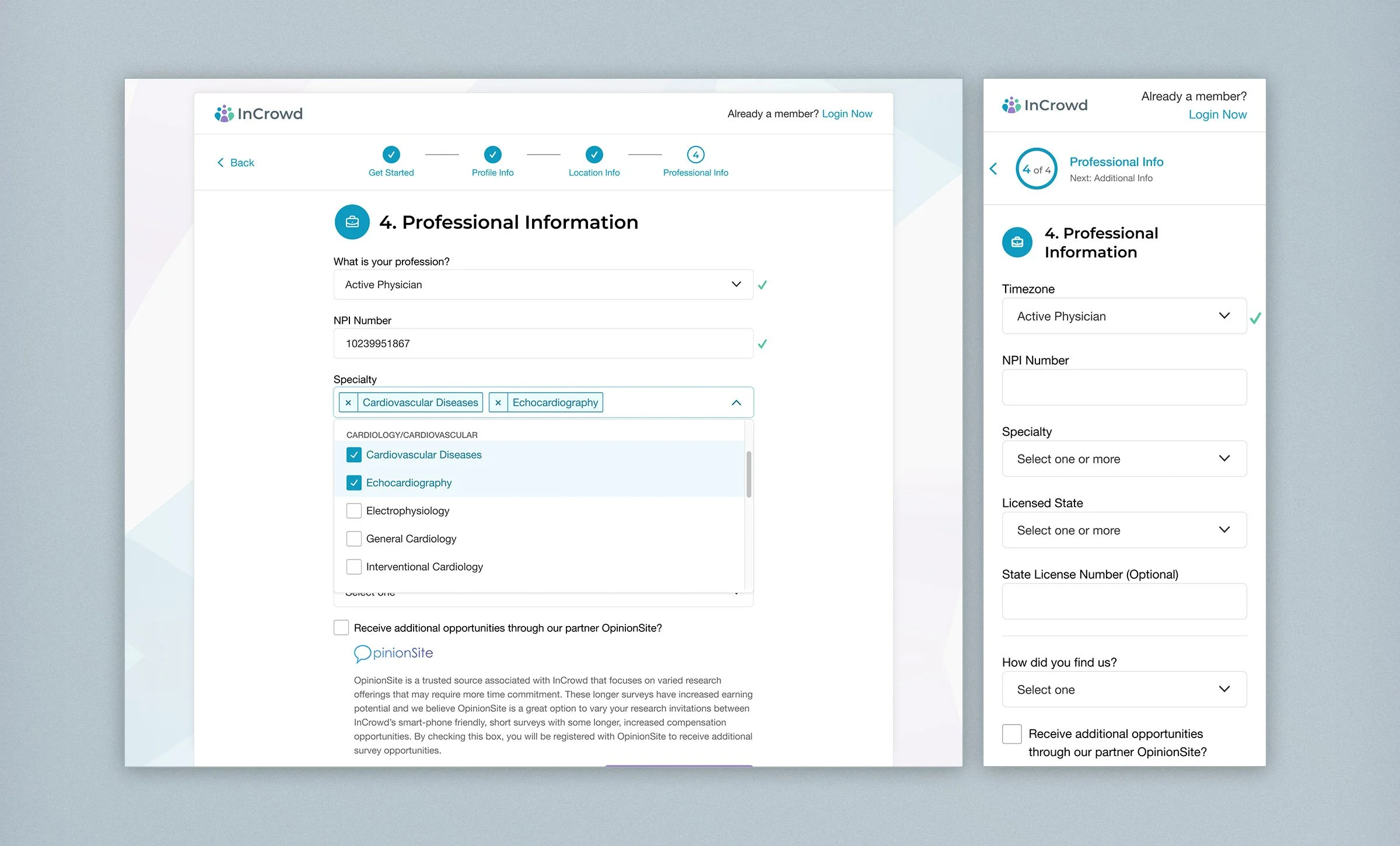
Professional information is the last step because depending on previous selections (location and profession) the options for other input fields (such as specialty and licensed state) will change.
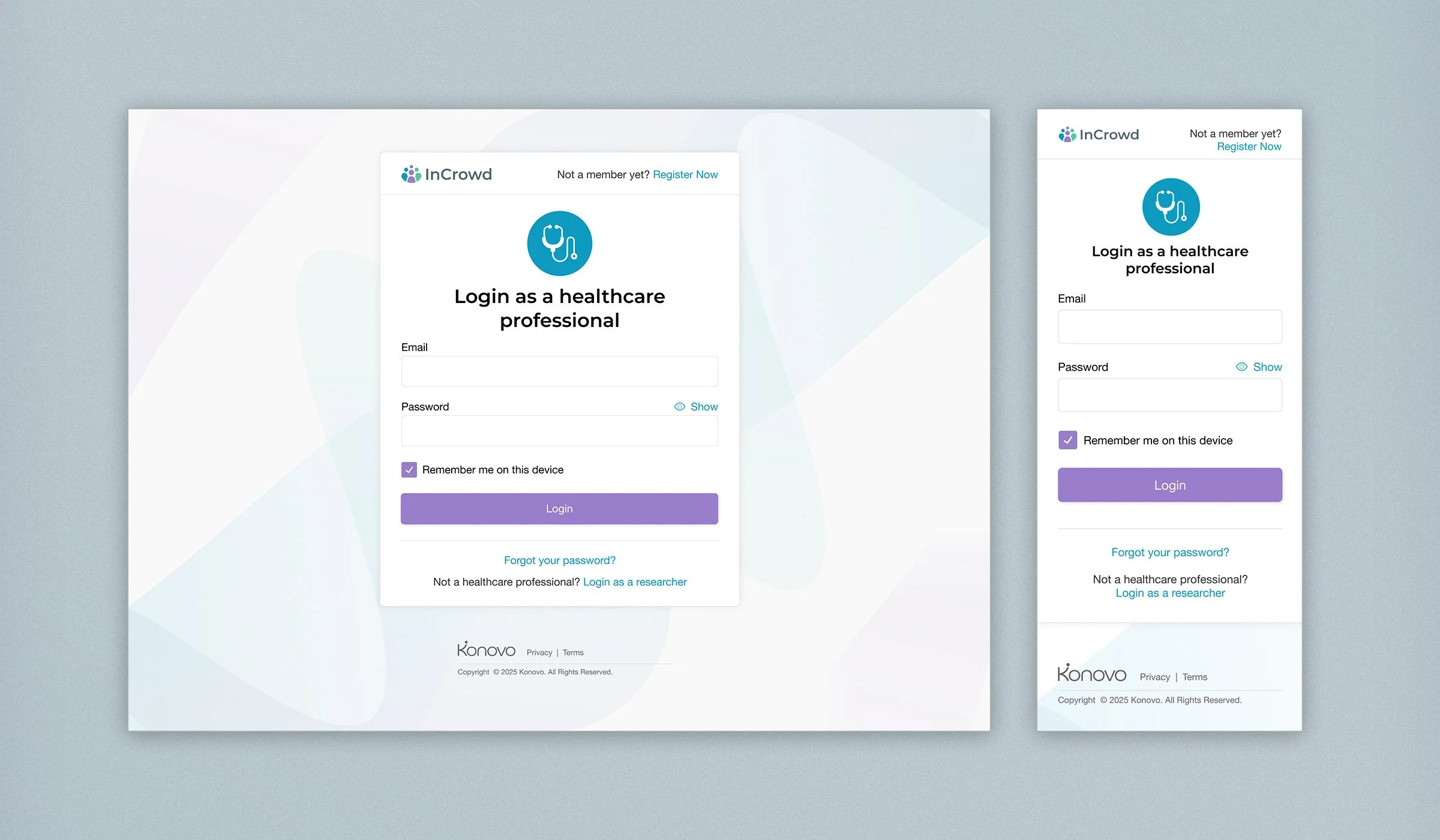
Login page was simplified and also adapts to user’s brand (InCrowd or OpinionSite).
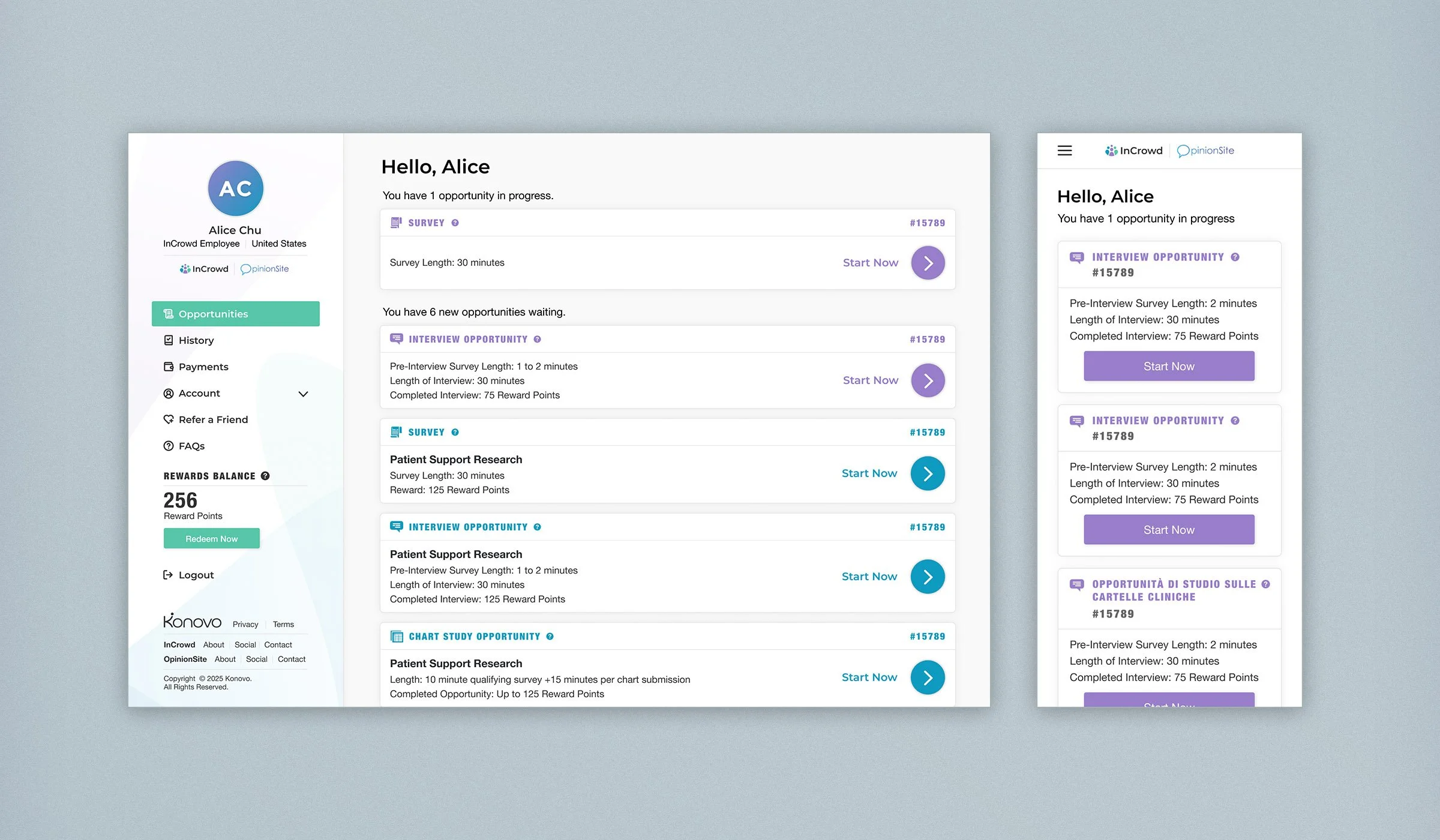
Opportunities were given much more context, giving more power for respondents to decide what opportunities to participate in.
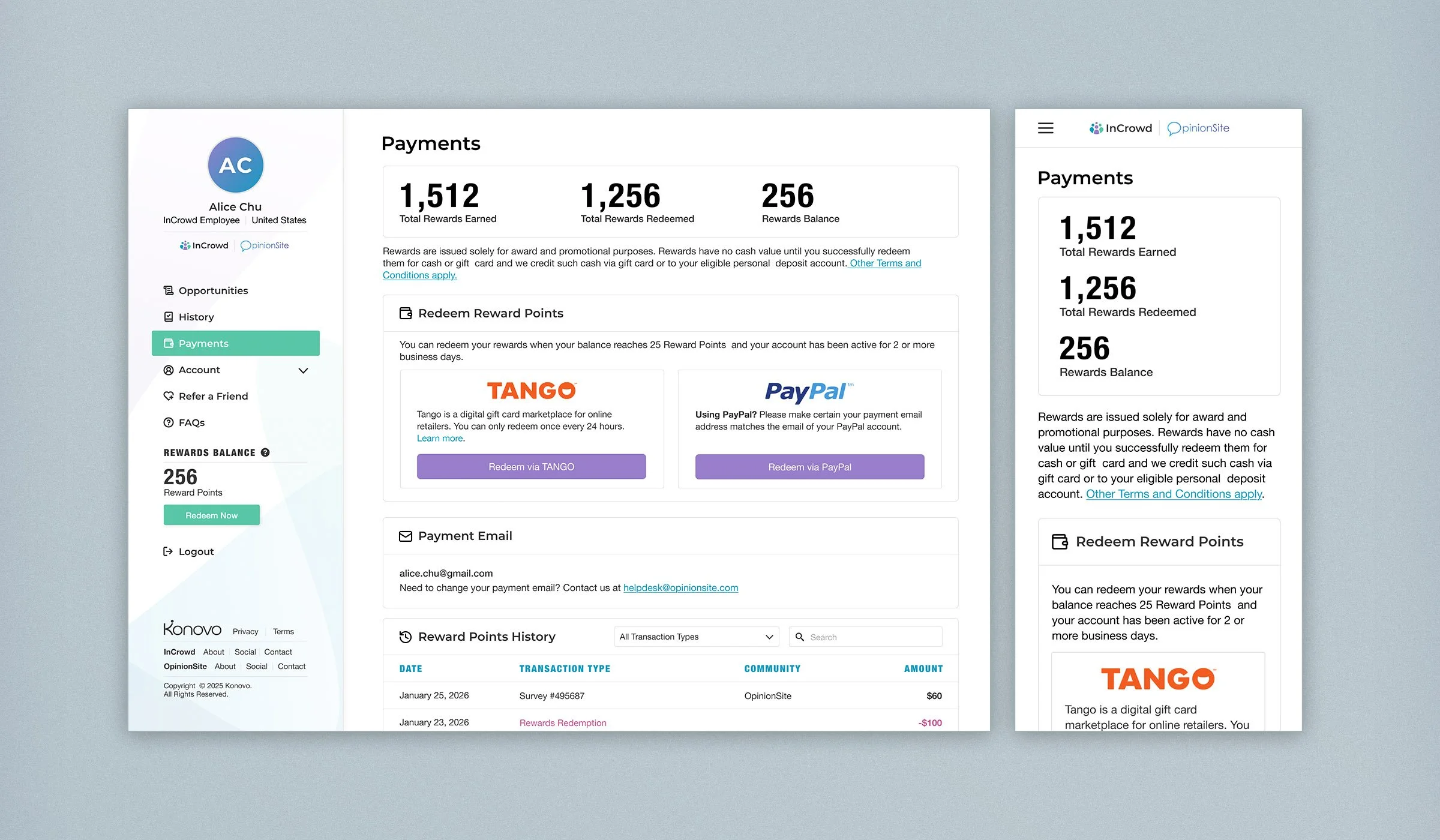
Through research we learned that one of the most frequently viewed pages is the respondent’s payments page. We made adjustments to make payments and redemption as clear as possible.